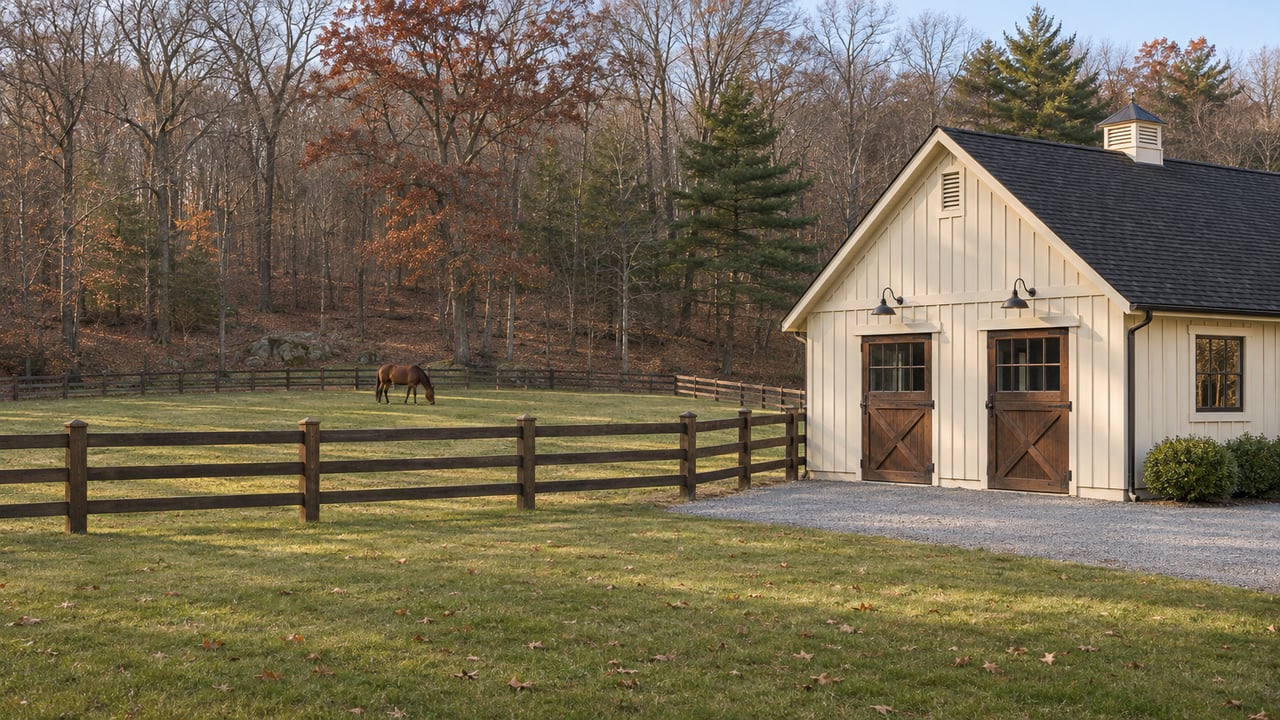
A buyer looking for a horse property in North Salem is choosing how many hours a day they want to work in a barn, and how many people they want on the payroll to do the rest. The listing calls it a choice between acreage and a stall count. The stall count matters most. A small barn means the owner does the daily work, double-digit stalls mean paid staff, and a stall count in the twenties means a business. Because several full-service boarding barns operate in town, a North Salem house with no barn at all is a reasonable choice for many owners of one to three horses.
The Full-Board Baseline Is Already in Town
Any home-barn decision gets compared against what full board covers locally. In North Salem, that comparison is easy to make.
Stony Creek Horse Farm on Baxter Road has 22 stalls in three main structures, along with indoor and outdoor rings, several large paddocks and 10 small paddocks, full-time grooms, a resident groom and a night check. According to the farm's own description, full board there includes daily stall maintenance, hay, feed, shavings, tack-up and light grooming. That list is the work a horse owner takes on when the barn is behind the house.
Old Salem Farm is the town's best-known equestrian address. Its facility page describes 120 acres with two indoor arenas, four outdoor rings, a Grand Prix field and more than 60 stalls, and it sends boarding inquiries to the farm directly. The show calendar keeps running into winter, with a holiday show listed for December 27 through 29, 2026. Out on Peach Lake Road, Vail Farm at number 773 lists hunter/jumper training and trail riding, and Beyaert Farm at number 855 is a show-jumping training and sales operation.
None of these barns posts a monthly board rate on the pages that describe them, so the price is a phone call. Still, a buyer can see what full board includes before they ever tour a house, and that is the right starting point. A barnless house within a short drive of a full-board barn gives the owner horses without the chores. A house with a barn gives the owner their horses in the backyard, and every chore on that list comes with them.
Three Stalls: The Owner's Barn
At the small end, North Salem horse properties tend to be built around a handful of stalls and a lot of turnout. In May 2025, Horse Nation profiled Windward Mark Farm, a 9.4-acre North Salem property with a three-stall barn, seven paddocks, a 110-by-180-foot outdoor arena, a grass dressage arena and trail access. That layout is built for an owner who rides their own horses and does much of the care themselves.
The barn is the smaller part of the cost. The ongoing inputs make up the larger part. University of Minnesota Extension uses a guideline of about 2% of body weight per day in combined hay and grain for an average adult horse. For an 1,100-pound horse, that is 22 pounds a day, or about 8,030 pounds a year. HayNow, a supplier that lists delivery to North Salem, sells tested small squares of about 43 pounds at listed prices of $16.50 to $26.50 a bale, with free delivery in New York. If that whole ration were bought as hay at HayNow's current listed prices, one horse would eat about 187 bales a year, or roughly $3,100 to $5,000. That figure is our own calculation. It is not a local average, and it moves with pasture, grain, waste and the price of the next delivery. Multiply it by three stalls before adding anything else.
The other costs are well known to anyone who has kept horses. University of Maryland Extension lists bedding, fence repairs, pasture management and tractor fuel as facility costs on top of hay, feed, farrier, veterinary and dental care. Minnesota Extension adds that manure management can be costly, though nearby farmers or gardeners may take manure as a resource. In a full-board stall, none of these show up as separate bills. At home, each one is a separate bill.
Eleven Stalls and a Groom's Apartment
The next step up is a different kind of property. In November 2025, the Westchester County Business Journal reported that Darlington Hall at 422 Hardscrabble Road sold for $7,265,000 after an initial listing at $9.25 million. The 83-acre property has a 10,000-square-foot manor home, an 11-stall horse barn with groom's quarters, a jumping field, a fishing pond, orchards and a carriage house with two apartments. The same report put the property taxes at $137,718 a year.
The groom's quarters say the most about how the property runs. A barn with eleven stalls and an apartment for staff assumes someone other than the owner is mucking out at 6 a.m. Will Stuart of Berkshire Hathaway HomeServices New England Properties told the Business Journal, "The buyers sought a property that offered this, along with privacy in an equestrian community within close proximity to New York City." At this scale, the buyer is purchasing an estate with a small equestrian operation inside it, and the operation needs staff.
For context on price, OneKey MLS reported a Westchester County single-family median sale price of $1,189,000 for the third quarter of 2026, with an average of 28 days on market and 2.5 months of supply, based on data as of October 7, 2026. Darlington Hall's price was about six times that county figure. A countywide median is a weak guide to what a working barn and dozens of acres will cost.
Twenty-Five Stalls Is a Business
Above that, the buyers are often professionals. In December 2021, the Westchester County Business Journal reported the sale of Autumn Farm at 306 Hardscrabble Road for $3.85 million. The 26-acre horse farm had two barns, 25 stalls, an indoor ring and a grand prix ring, and the buyers were described as equestrian trainers. That sale is now several years old, so treat it as an example of a type of property. It is not current pricing.
What it shows still holds. Autumn Farm had fewer acres and a lower price than Darlington Hall but more than twice the stalls. A property built mostly for horses usually sells to people who earn a living from horses. A private buyer with two horses who buys that kind of facility will need to staff it, lease out the extra stalls, or leave most of it empty.
What Comes With Either Choice
Whether the horses live behind the house or down the road, the infrastructure around them is the same, and that is part of why the barnless option works here.
The North Salem Bridle Trails Association maintains a historic network of more than 100 miles of trails connecting North Salem and Ridgefield, Connecticut. Away from town property, conservation land and roads, the trails cross private land through landowner cooperation. The private-land trails are open to horseback riding by current members only, and membership is handled through the association. A rider who boards and a rider who keeps horses at home join the same way.
Veterinary care works the same way. New England Equine Practice runs its hospital at 2933 Route 22 in Patterson, says it is accessible from Westchester, Putnam and Fairfield counties, and lists a 24-hour line at (845) 878-7500. For tack and supplies, the association's directory lists Beval Saddlery at 20 North Salem Road in Cross River and The Horse Connection at 38 Village Green in Bedford. Golden's Bridge Hounds holds three hunter paces a year, including a spring pace in North Salem. None of these depend on the size of the owner's barn.
The barn decision, then, is mostly about daily labor and staffing, because the trails, the vet, the supply shops and the shows are available either way. A buyer with one or two horses who travels, works long hours or wants a professional managing their horses' care can buy a house with no barn, board at a full-service barn in town, and ride the same trails as a neighbor with a barn. A buyer who wants the horses outside the kitchen window should look for three or four stalls with good turnout and budget for the hay. A buyer looking at eleven stalls and groom's quarters is choosing to employ people, and should price the property on that basis.
Questions Buyers Ask
Does a horse property in North Salem need a large barn to hold its value? Recent sales point to a range of barn sizes. Darlington Hall had an 11-stall barn as part of a larger estate, and smaller properties like Windward Mark Farm are built around three stalls and extensive paddocks. The right barn size depends on who will run it.
Can a boarded horse use the same trails as a horse kept at home? Trail access on private land goes with membership in the North Salem Bridle Trails Association. It does not depend on where the horse is stabled.
What does full board cover locally? At Stony Creek Horse Farm, full board covers daily stall maintenance, hay, feed, shavings, tack-up and light grooming, with other services by request. Rates at the town's barns are given by inquiry.
The figures in this post, including the hay estimate and the reported property tax, are general information and not legal, tax or financial advice. Confirm your own numbers with the appropriate professional before making a decision.
The Will Stuart Team works with barns, arenas and acreage across northern Westchester. If you want to compare a three-stall property, a full equestrian estate and a barnless house near a boarding barn before you make an offer, we would welcome the chance to schedule a personalized consultation.