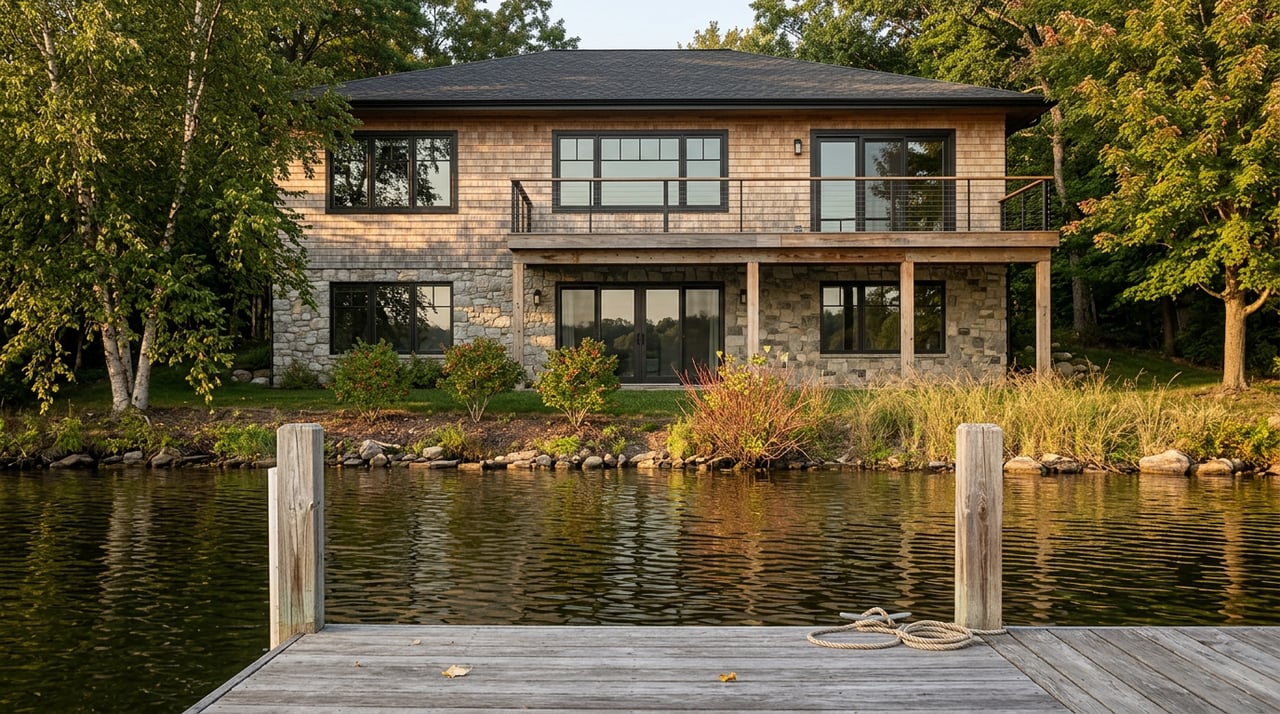
Most buyers assume that when a listing says "direct waterfront" on Candlewood Lake, the sale includes the water at the end of the lawn, plus whatever dock sits on it. On Connecticut's largest lake, that assumption is usually wrong. For the overwhelming majority of shoreline owners, the deed stops well short of the water at a line called the Rocky River Project Boundary, and the strip of land and lake bottom beyond it belongs to FirstLight Power, the company that operates the hydroelectric station that created the lake. Everything past that line, including the dock, is something you're permitted to use, not something you own outright. That distinction rarely surfaces until a survey, an inspection contingency, or a title search brings it forward, and by then a buyer who thought "waterfront" meant unrestricted access to the water is negotiating from a position they didn't know they were in.
That's the thing worth sitting with before writing an offer on a Candlewood Lake home. The line between your property and the water is not where the shoreline appears to stop. It's a federally regulated boundary tied to a hydropower license, and it shapes what you can build, what transfers automatically at closing, and how far the lake itself can drop under your dock in a given winter.
The Line Called the Rocky River Project Boundary
The Candlewood Lake Authority calls it the Rocky River Project Boundary, though longtime residents still refer to it by its older name, the 440-foot line. About 95 percent of Candlewood Lake's waterfront property owners own their land down to this boundary, but not below it. Your deed will tell you exactly where that line falls on your lot, and because it doesn't track a simple elevation contour in every location, locating it precisely usually requires a land survey rather than a walk down to the water.
Past that boundary, FirstLight Power owns the land and the lake bottom, all the way to and beneath the water. That ownership is not incidental. FirstLight holds the property because federal licenses issued for the hydropower stations on the Housatonic River require the company to control shoreline within a defined project area, balancing power generation, flood control, and public recreation along the way. Practically, that means cutting down a tree, clearing vegetation, building or modifying a seawall, adding a retaining wall, putting up a shed, or changing the size or configuration of a dock all require FirstLight's approval before they happen, not just the town's. Skip that step and you risk being asked to undo the work, or worse, facing legal action from the landowner.
Why the Dock Doesn't Come With the House
Here's where the assumption breaks down for most buyers. A dock that has sat on a property for twenty years looks like a fixture, the kind of thing buyers may assume comes with the house the way a furnace or a fence does. Permits for docks, seawalls, and other shoreline structures run through FirstLight's own permitting process. Bart's Tree Service says a new owner must apply for a land use permit from FirstLight; FirstLight pre-screens the request before the town takes its own pass at sign-off.
That two-step process, FirstLight first, then the municipality, is easy to miss if nobody flags it during due diligence. It's also the reason a home inspection alone won't catch the issue. An inspector can tell you the dock is structurally sound. Only a records check, a call to FirstLight, or a knowledgeable local agent will tell you whether the permit is current, whether it's in the previous owner's name, or whether it was ever filed at all.
| What buyers typically assume | What's actually true on Candlewood Lake |
|---|---|
| The dock is part of the house and transfers automatically | The dock is subject to FirstLight's permitting process, and a new owner must apply for a land use permit |
| "Waterfront" means the deed reaches the water | For roughly 95 percent of owners, the deed stops at the Rocky River Project Boundary, well short of the water |
| A structure that's been there for years is grandfathered in | Unpermitted moorings are subject to removal, and modifications without approval can trigger mitigation or legal action |
The Lake Moves Every Winter, and Sometimes More Than Planned
Candlewood Lake also isn't static the way a natural lake is. FirstLight manages water levels for the hydropower station, which means the lake has a normal summer operating range, roughly 429.5 to 427 feet, and a separate, lower winter range that the company sets each year and lowers on a schedule known as the drawdown.
For the 2025-2026 winter season, FirstLight had planned a shallow drawdown targeting 424 feet, with a two-foot winter operating range between 424 and 422 feet, and homeowners were told to pull docks, boat lifts, and other structures out of the water beforehand to avoid ice damage. Then, in late January 2026, a sustained cold snap across New England triggered a rare emergency order from the U.S. Department of Energy directing regional power generators to maximize output, the first such order to the New England grid since 2003. To comply, FirstLight deepened the drawdown well past its original plan, down to a range of 420 to 418 feet, while telling the public it still intended to have the lake back in its normal summer range before Memorial Day 2026. The episode is a useful reminder for anyone buying here: the depth of a given winter's drawdown is not fixed the moment the season's plan is announced. It can be revised mid-winter for reasons that have nothing to do with the lake itself.
For a buyer touring a property in the off season, that means the shoreline you're looking at in January may bear little resemblance to what you'll see from the same dock in July, and the timeline for removing and reinstalling shoreline structures each year is a genuine seasonal obligation, not a suggestion.
A Plan That's Being Rewritten Right Now
The rules governing all of this, the permit fees, the process for approving a new dock, live in a document called the Shoreline Management Plan, which FirstLight must review and update periodically under its federal license. The version currently in force was approved by FERC in 2019. FirstLight has since filed a revised update as part of its required six-year review, and as of a March 2026 notice, FERC had formally accepted that application for filing and opened it to public comments, motions to intervene, and protests. Until FERC rules on the update, the 2019 plan is what governs every permit application on the lake today.
That timing matters more than it might seem. If you're buying a property with an existing dock, it's worth asking when that structure's permit was issued and under which version of the plan it was approved. If you're selling, documenting that paper trail now, while the currently approved plan is still the standard being applied, protects you from having to reconstruct permit history later under a different set of rules. Either way, this isn't a detail to leave for after closing. The plan on the books can change while your transaction is in process
Frequently Asked Questions
Does this restriction apply to every home near Candlewood Lake, or only true waterfront? It applies specifically to the roughly 95 percent of Candlewood Lake waterfront owners whose deed reaches only to the Rocky River Project Boundary. Homes set back from the shoreline, even those with lake access through a community beach or association right, present a different buying consideration.
What happens if a dock or seawall on the property was never permitted? Per the Candlewood Lake Authority, unpermitted moorings are subject to removal by FirstLight, and modifications made without approval can result in required mitigation or legal action. It's worth confirming permit status before you're relying on that structure for your own boat or dock use.
Does the deeper winter drawdown affect the swimming season the following summer? Not by design. FirstLight's stated plan, even after deepening the 2025-2026 drawdown for grid reasons, was to have the lake back in its normal summer operating range before Memorial Day. What the drawdown reliably affects is the fall deadline for removing docks and lifts, since ice damage risk doesn't wait for the final target to be announced.
Buying or selling on Candlewood Lake means dealing with a shoreline that answers to a federal license before it answers to a deed. That's not a reason to avoid the lake. It's a reason to have someone in your corner who already knows where the Rocky River Project Boundary sits on a given lot, what a dock permit's history should look like before you rely on it, and how a pending Shoreline Management Plan revision might touch your closing timeline. The Will Stuart Team works these details into every Candlewood Lake transaction we handle. If you're evaluating a waterfront property here, schedule a personalized consultation before you write the offer, not after the survey comes back.
This article is general information, not legal, tax or financial advice. Consult a qualified professional about your situation.